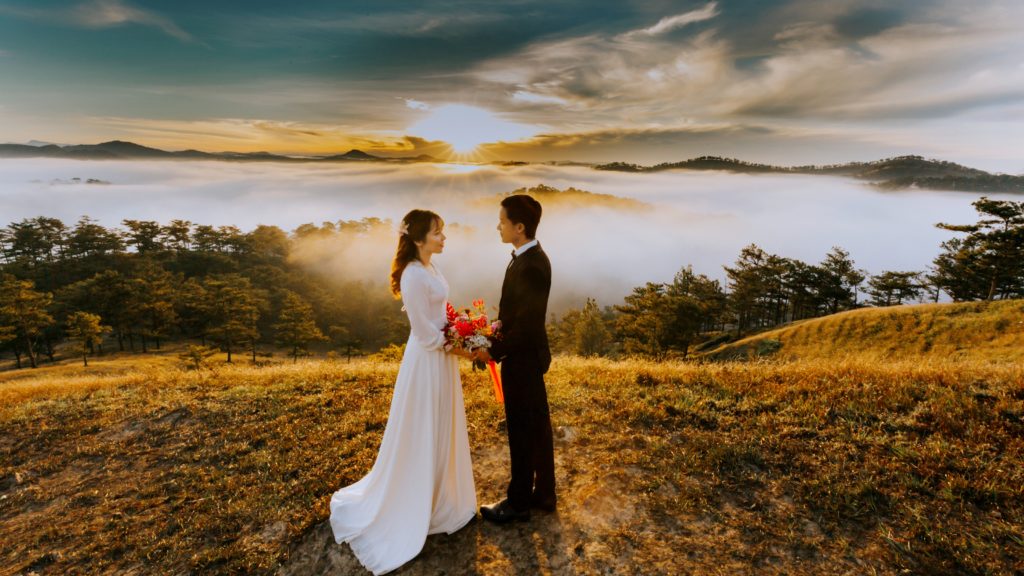
Declaring two people married is an incredible honor. You’re getting to spend time with them on one of the best days of their lives. It’s many hours of work to craft and oversee the perfect wedding ceremony, but the end result is worth it even if the pay is low. I get to put a pin in this one day, a day that the couple will reflect on for years to come. I’ve never done work more satisfying.
Here are just a few of the reasons why I relish being in the marrying business:
Happiness is infectious
Weddings are happy occasions. Everyone there is rooting for the day to go well, and the guests of honor are surrounded by professionals who know how to ensure that it does. Caterers, photographers, florists, musicians, videographers, and officiants have seen it all—which means that even if there is a snafu, you might not see it yourself. That makes it all the easier to be lifted up on the rush of wedded bliss and yes, that is infectious! When I see the love shared before those guests, it puts a pep in my step. Weddings keep me happy, and weddings keep me young.
Couples are creative
I am a resource for what to do to personalize a wedding, but thankfully officiants are not the only resource or these ceremonies would become very, very boring. Couples propose novel ideas to me all the time, and I love that! I am up for anything, and I don’t want to get stuck in the rut of doing the same old thing. Need me to attend in a cloak, a Santa outfit, or birthday suit? I’m game. Want to exchange rings in the middle of a babbling brook without dropping one in the water? Let’s work it out. Need me to learn a blessing in a real or fictional language? Just get me the phonetics. Need to figure out how to incorporate bees into the ceremony? I’ll help you tell them about it. I’ll always suggest ideas if they fit with your style, but your imagination can take the lead whenever you like.
Fashion is fabulous
Those in a wedding party always like to put their best foot forward, but really everyone who goes to a wedding is saying something with their clothes. I love to see what people are wearing. My typical look includes tight braids, a stole over a sport jacket, and smart pair of Converse. Most bridal gowns have been white for a long time, but even if you stick with that tradition there is a lot of flair that can be added—especially for attendants. Guests have an even more free range.
Wedding venues are stunning
I’ve celebrated weddings on Hudson bluffs, in swanky catering halls, venerable chapels, decorated weekend rentals, lovingly appointed backyards, at the top of ski lifts, and at serene meditative resorts and city parks. No two are alike, but one quality they share is that they all are beautiful. Even if the weather is ominous, the location is invariably perfect, and it’s a real treat to get to see these locations when they’re being used for such a joyous occasion.
The secret is that weddings are magical, and wherever you choose to have yours, it’s going to be fantastic. This is a peak rite of passage that transcends culture and tradition. We have been choosing to marry for well over 43 centuries, and that’s only including what’s known from written records. It is an ancient practice that brings to bear the presence of our ancestors. There is a lot of seen and unseen forces working to ensure that beauty is all that remains for this day, and I bask in every moment.
Yes, the organizing can be stressful at times because there are a lot of factors to consider, but when you look back at your wedding, you will find that on this day, in this place, with these loved ones, this is a high point. It is my heartfelt honor to be part of your special day.
From time to time, a couple will want to include an element in the ceremony that’s unfamiliar. That’s something to talk about as soon as possible—ideally before even signing a contract. Wedding clients have every right to have confidence in their officiant to do what’s needed.
Sometimes, a specialist is going to be the best fit: someone who was steeped in the culture from childhood, or has been ordained in a certain religious practice. It can be the obvious choice if this is a wedding between people who share their background completely, or if certain traditions are extremely important to one and not at all important to others. If initiation into a closed religious or cultural tradition is required, by all means don’t ask this of an outsider. That would be disrespectful to all concerned.
Bringing together elements from different sources, though, is where an officiant with a background in multi-faith and non-theistic weddings can shine. This is the officiant who will admit to ignorance, if your preferred religious or cultural element is a novel one. That’s a good start.
Every ritual element is new to every celebrant at some point. You’re much better off with an officiant who admits to being unfamiliar. You can point an honest officiant toward authentic sources of knowledge, while the faker might just hallucinate with AI and never let you know. An open, curious mind is often the best quality in an officiant.
There may be as many ways to represent marriage as there are grains on sand on a beach. Beach sand, in fact, is part of one of these, the sand ceremony. Some couples like to take to the air by jumping the broom. Others show their bond with a ribbon or cord. Couples might share a drink, or smash a glass. These are not interchangeable parts—each carries with it symbolism particular to the people who practice it.
Whether you begin with your roots to decide what to include in your wedding, or with an internet search, or deep within your own imagination, hire an officiant you feel can be a partner in the creative process. That might mean sharing research tasks, but you could just need the officiant to say the exact words and perform the precise gestures that are required. Your level of comfort and confidence is far more important than the officiant’s present level of knowledge.
That’s why you should do more than exchange emails before hiring anyone: demand a conversation in person, or a video conference. Your heart will know even if your brain gets flustered.
Do you have non-human family members who are going to be part of your special day?
Many of the couples getting wed in or around the Gunks lately have pets in their lives. Cats and dogs especially were part of the pandemic experience, and became part of our lives.
Those pets are part of your household, and you might be thinking about including them in the ceremony. That might not be very easy if your special friend is a freshwater fish, but there’s a lot of air-breathing pets who could possibly be included. You know your pet better than anyone.
Some pets have been part of a shared household with the humans getting married for all their lives. Others are family members of one or the other, and setting up housekeeping includes figuring out how to weave in those routines. If your pet is getting used to a change in the household, that might be enough to process without adding in a wedding. Again, you know your pet better than anyone.
Dogs of all sizes can be ring-bearers, and while cats who are comfortable with crowds seem to be less common, they can too. Whether your ring-bearer is a cat, a dog, a juvenile human, or a mynah bird, you are going to need at least a ring-bearer wrangler, or else a ring-bearer bearer. Whoever bears the rings, they will do better if they are used to larger numbers of humans. If you don’t know your chosen ring-bearer well enough, ask their caregivers about their temperament in groups of strangers.
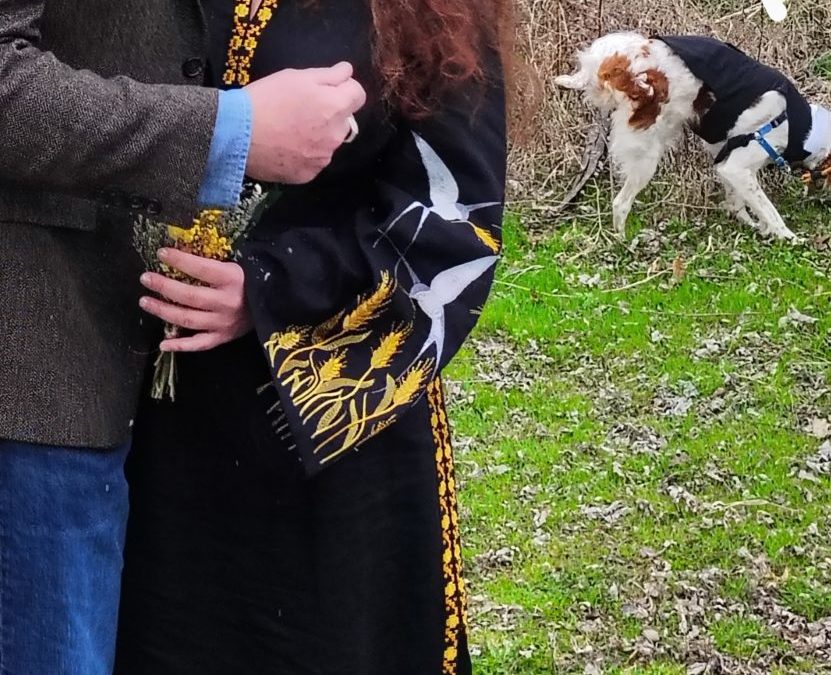
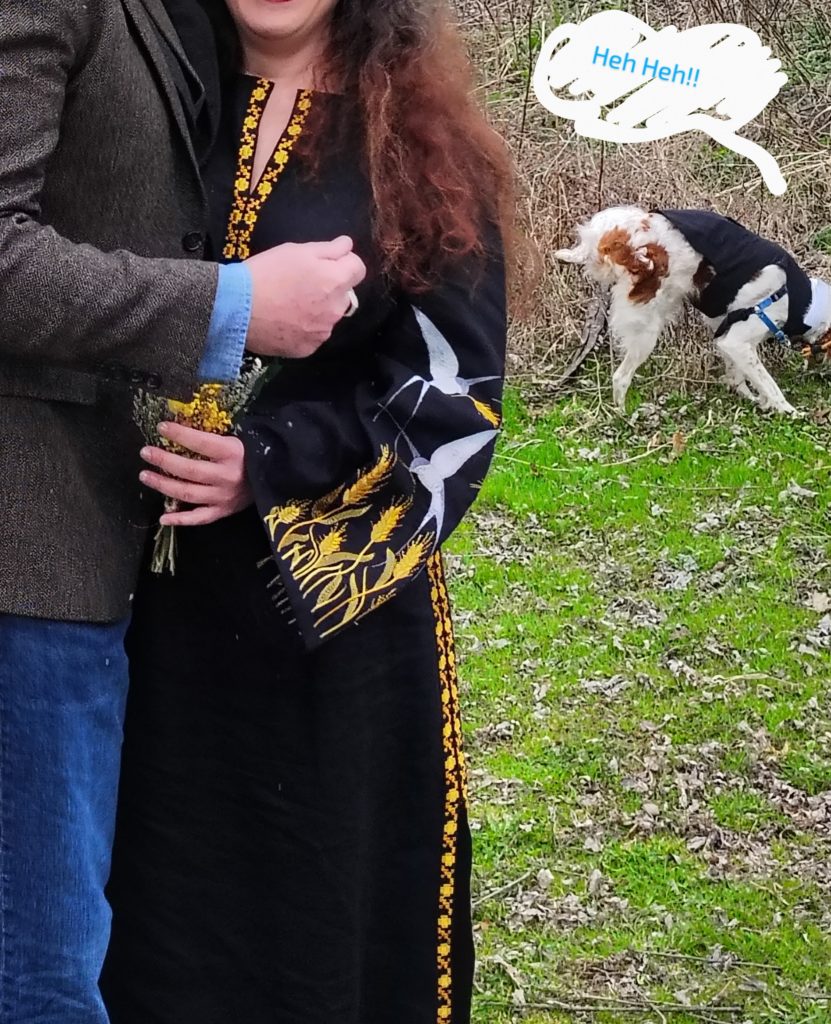
Not every animal can be assigned to carry jewelry or check invitations at the door, but that doesn’t necessarily mean that they can’t be in attendance if their behavior won’t be disruptive. You get to decide what behavior counts as “disruptive,” though: for one couple who only brought friends to witness, leaving their dog at home wasn’t a consideration. It should be clear from this picture they sent that not much was going to disrupt their day! For others, maybe that would have been too much.
Non-human wedding guests can be every bit as important as the human ones, but it’s certainly worth balancing the desire for pets to be present and any allergies, fears, worries, and sensibilities of the others invited. How best to weigh those issues will vary based on the couple yourselves, and the guests you’re inviting. If nothing else, this officiant is not allergic to any animals.
To get a license to marry in the state of New York, you have to apply for it in person—both of you, as New York law limits the number of spouses to one. As of this writing, there are no other options. This can be done at the office of any town or city clerk in the state. Clerks in bigger cities dedicate staff members entirely to processing marriage documents. It doesn’t matter where in the state you plan on getting married, and it doesn’t matter where you live. If you will be getting married within New York, then you can get a license from any clerk in New York.
According to state law, two adults (aged 18 years or more) may get a license to marry each other if they can produce proof of age and identity. New York being a state where home rule is a big deal, it’s the individual clerks who make the decision as to what counts as evidence, and what doesn’t. It’s unlikely any of them would object to state-issued identification, or official birth records, and documents of that sort, but if you have anything different it’s probably a good idea to find out if your documentation is acceptable in that clerk’s office.
Gender limitations on marriage were eliminated with the signing of the Marriage Equality Act in 2011, eight years after Jason West married multiple same-sex couples in New Paltz.
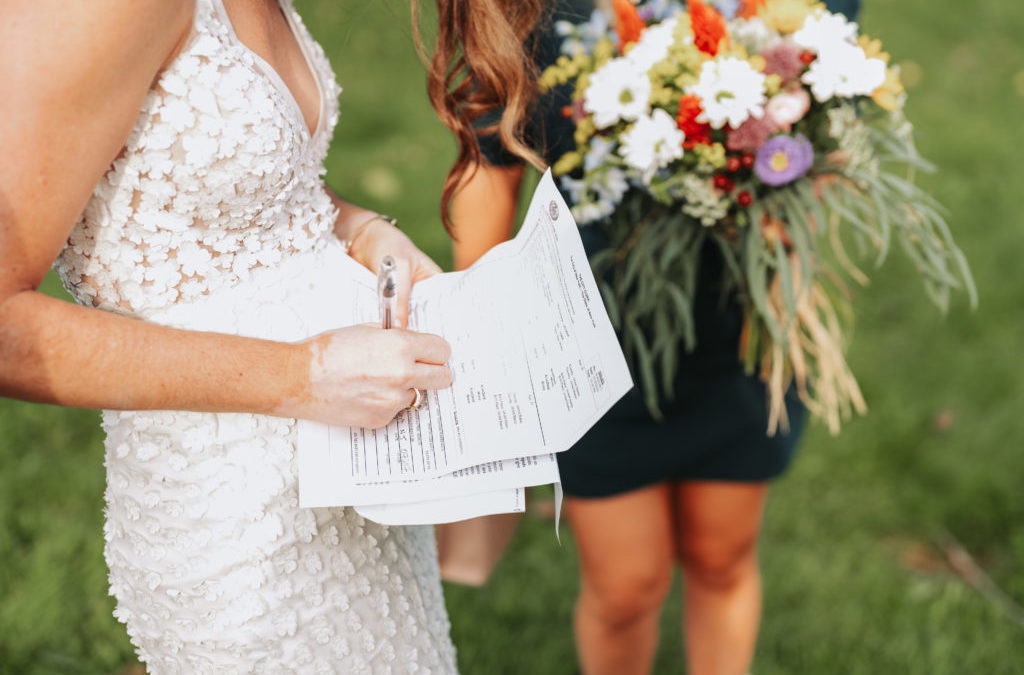
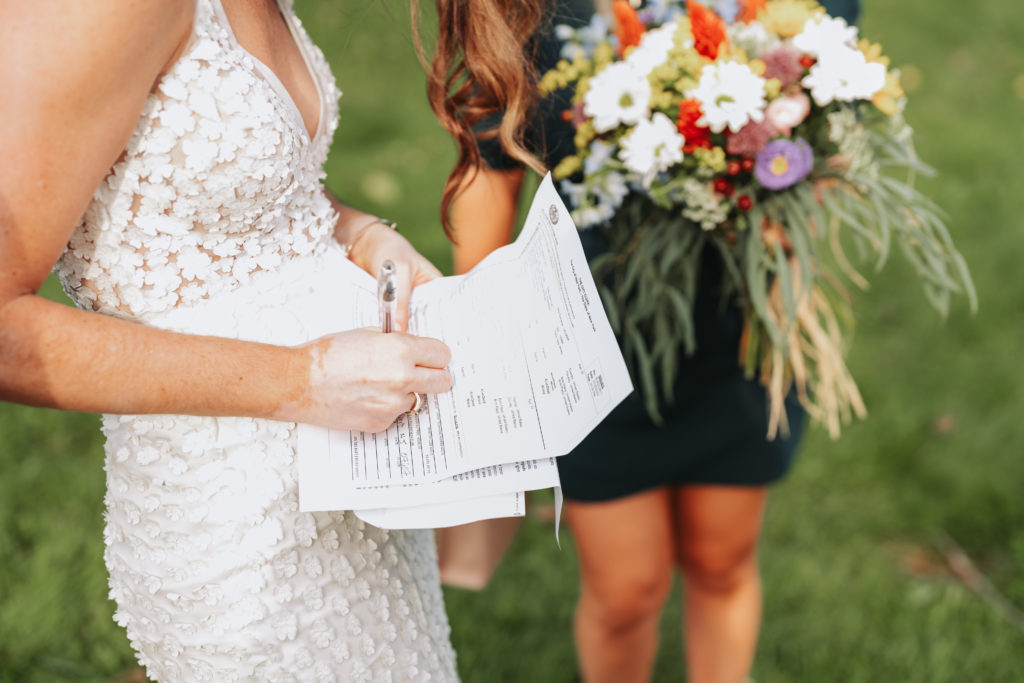
Marriage licenses aren’t usable until exactly 24 hours after they are issued, unless a judge waives that waiting period. It’s good for 60 calendar days from that point on. As soon as the ceremony is complete, fill in the date, time, and location in the appropriate fields. Your officiant will double-check to make sure nothing is missed.
This is also when witness and officiant signatures are executed. There is space for two witnesses, but only one adult is required. Usually, addresses are requested of all these parties.
Licenses usually come with a pre-addressed return envelope. At Weddings in the Gunks, mailing the completed form back after checking for accuracy is one of the responsibilities given to the officiant in the contract, but any client who wants to take that one is welcome to strike that clause entirely. The normal process includes providing pictures of the license just prior to mailing, and sending it back certified mail with return receipt requested. Past experience shows that there is never a guarantee that even certified mail will not be lost in transit, but requesting tracking provides peace of mind.
If you’re in a polyamorous relationship, taking the next step is more complicated. Given that everything is a bit more complicated in a polycule, you may be uniquely prepared for this challenge.
Marriage, as defined in the United States, is a legal relationship limited to two adult human beings, which means that you’re going to have to get creative if you want to include marriage in your formal commitment. This is by no means required; anyone can have a commitment ceremony whether or not there will also be a marriage. Hiring a officiant who customizes each and every ceremony is important for that process; here’s some considerations as you work through your ideas.
How will you communicate with your officiant?
If you’re in a healthy polyamorous relationship, then you have gotten very good at communicating with one another. Even if your officiant is also experienced with polyamorous relationships, that officiant isn’t part of your polycule. Give some thought as to how you communicate among yourselves, and then ask your officiant for input on how to work together. The clearer everyone is on how you want to work together, the smoother the process will be. Consider asking questions such as:
To what extent does each of you want to be involved in creating the ceremony script?
Can you be disciplined enough not to talk over each other, to be mindful that the officiant may be taking notes?
Will you make space for your officiant to talk with each of you regardless, to get a sense of your individual personalities?
Will there be a legal marriage as part of the ceremony?
Just because marriage is limited to two individuals doesn’t mean that marriage can’t be part of the plans for your polycule. For example, I’m familiar with a four-person polycule who got married as two couples. There are legal benefits to marriage that are more difficult to recreate outside of that context, and just because your loving family is more complex than the societal norm doesn’t mean that you don’t deserve those benefits. However, due to that additional complexity, it’s probably worth it to consult some professionals, such as an estate lawyer and an accountant. If you can communicate your goals to these consultants, you may emerge with a strategy for how to achieve them.
On the other hand, there is no requirement that any marriage license be involved in this process. What works for one polycule isn’t necessarily the best option for any other. Communicate with one another, and take the time to test your own feelings.
ceremonial
Incorporating symbolism of unity into a polyamorous commitment ceremony
Many of the classic unity elements are designed for two people, but can be adapted.
Rings: it’s relatively easy to include rings as a symbol of this commitment. A ring-warming isn’t changed much at all; the main factor for this is the number of guests participating. For the actual exchange, thought must be given as to who shall place a ring on whose finger, and in what order. It might even make sense to do this simultaneously.
Handfasting is a beautiful way to show the connections among the ceremony participants, but the knot that’s commonly tied is designed for two people to pull the ends. For more than two, the officiant may be doing additional work, but that doesn’t make it any less beautiful.
Sharing a cup such as the traditional Scottish quaich can be quite profound with three or more pledging their love or commitment to one another.
Sand ceremonies are also easily adapted to more than two, and the result can be a beautiful sand painting which will serve as an enduring reminder of how you have blended your distinctive energies together.
Vows are perhaps more important for three or more than they are for a mere couple. You are committing yourself to each individual, and to the entire polycule. This is a moment when you can declare to each other, your guests, and the entire universe what you mean to each other, and how you intend to show it. For that reason, canned vows might not cut it. Your officiant might have suggestions as to the types of promises to make and things to say, but as with everything in the polyamorous life, communication with your partners is essential.
When it comes down to it, love is love. Not all love has a legal definition, and that’s okay. If you’re ready to declare your love before friends and family, send a message! Your love deserves a lovely ceremony.
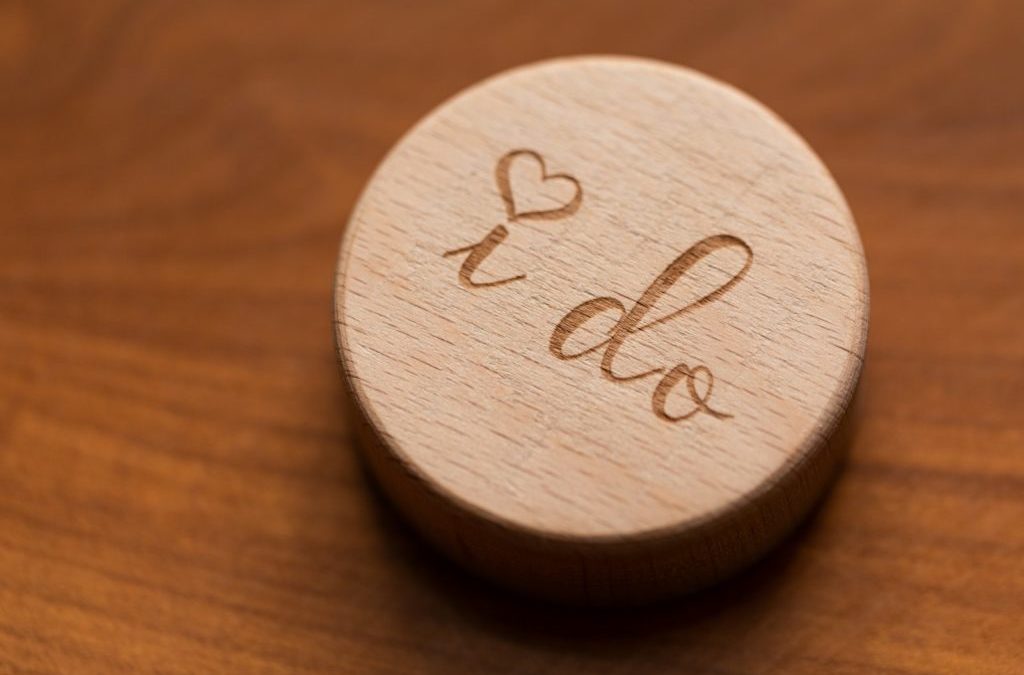
The goal of any legal wedding—and a decent number of other commitment ceremonies—is to seal the deal with “I do” or other language that clearly states, “Yes, I will marry you.” How we get to that point of the wedding, what comes before and after, and all the rest is, in New York at least, pretty much up to you. That’s why every ceremony offered through Weddings in the Gunks is created using a collaborative process that ensures that it is going to reflect your values.
One of the basic decisions in the classic American wedding format is whether this portion of the event is going to be phrased as a question, or a call-and-response process, or if the words will memorized ahead or time or read from the page entirely by the couple themselves.
Here’s the language that many will find familiar, if not from their own experience, from popular culture:
Do you take this person to be your lawfully wedded spouse, to have and to hold from this day forward, in sickness and in health, in poverty and in wealth, for as long as you both shall live?
This is the declaration of intent, which is central to any wedding. In this format, each person would respond to the question with the classic “I do,” which is what everyone is there to witness.
When it’s done as a call and response, the officiant feeds the words to each participant:
Repeat after me: “I, Chrysanthemum,”
“I, Chrysanthemum,”
“take you, Pennyfarthing,”
“take you, Pennyfarthing,”
“to be my lawfully wedded spouse,”
“to be my lawfully wedded spouse,”
“to have and to hold,”
“to have and to hold,”
“from this day forward,”
“from this day forward,”
“in sickness and in health,”
“in sickness and in health,”
“for richer or for poorer,”
“for richer or for poorer,”
“for as long as we both shall live.”
“for as long as we both shall live.”
There is no explicit “I do,” but the declaration of intent remains.
In the third variant, you’ll either memorize the whole shebang, or have it printed in a handy format to read aloud. (Your Weddings in the Gunks officiant always has a copy of the entire script, which will come in handy just in case something goes awry with and there’s nothing to read from.)
How do you want to get to “I do?” The choice is up to you.